Imagine having to decide whether it is more dangerous to stay in your home or leave it. You have a family to protect, but the journey ahead could put them in danger too. There is no easy choice, and no guarantee that you will find safety when you arrive.
 LISTEN ON APPLE PODCAST
CLICK HERE
I thought about that throughout my conversation with Mary Fontana. It is easy to have an opinion about immigration when we speak in broad terms. It becomes harder to speak so casually when we hear what one family has lived through.
Mary has been involved with migrant hospitality efforts at the U.S.–Mexico border for more than 20 years. In her book, Strangers in the Province of Joy: Practicing Radical Hospitality on the U.S.–Mexican Border, she tells the story of Annunciation House in El Paso, Texas. It is a story about migration, but also
about the people who decided to open their home and welcome those arriving at the border.
They began by listening
Nearly 50 years ago, a group of young Catholics asked one another how they could live with deeper meaning and purpose. They moved into an old house near the border, though they did not yet know what kind of service they would offer.
I was struck by their willingness to wait and pay attention. As they got to know the neighborhood, they learned that undocumented people had few places to turn for food and shelter. They responded by opening their doors. What they began continues today.
Mary arrived at Annunciation House as a volunteer in 2004, shortly after college. She had expected to spend a year in service, but the place and it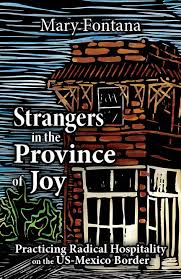 s people became part of her life. Today, she serves on its board. Her book draws on conversations with volunteers and guests across the house’s history.
More than a bed for the night
At Annunciation House, people who stay there are called guests. That word caught my attention. As Mary explains, the volunteers live in the house. They are inviting people into their home. They cook and eat together, wash dishes together, and learn one another’s names.
A meal and a safe place to sleep matter enormously to someone who has gone without them. So does being treated as a person with a story, a family, and a place at the table. Some guests stay only briefly. Others remain long enough to build friendships and help welcome the people who arrive after them.
The founders made sacrifices to live this way. Mary shares the story of Delia, who left college just a few credits short of finishing her degree. Her family had worked hard to give her opportunities beyond the poor neighborhood where Annunciation House stood. Yet Delia felt called to return and live alongside the people arriving there. Listening to her story, I could understand her family’s concern and the strength of the choice she made.
The journey does not begin at the border
Mary and I also talk about what can lead a person to leave home. In her writing, she asks readers to consider the choices facing a family threatened by violence. Then come the risks of the journey itself. By the time someone reaches the U.S. border, they may already have endured far more than we can see.
Mary asks us to look at the larger picture, too. We discuss ways U.S. actions and immigration policies have helped shape the conditions that cause people to migrate. We do not have to pretend these questions are simple to listen carefully to the people living with their consequences.
What stays with Mary
When I asked Mary why she remains involved with Annunciation House, she spoke about the moral courage she has witnessed in its guests. Many have traveled under frightening circumstances to protect a child or support family back home. Knowing them, she said, has challenged her to become more compassionate.
That stayed with me. We may never know what another person had to do to reach our door. We can still choose how we greet them when they arrive.
I hope you will listen to my conversation with Mary on Your Radical Truth. Her book and the people of Annunciation House offer us a chance to look beyond the arguments and see the human beings at the heart of this issue.
Learn more about Mary’s writing at maryfontana.com.
About Mary Fontana
Mary Fontana is an award-winning writer whose work explores migration, faith, and the meaning of hospitality. For more than 20 years, she has been involved with Annunciation House, a community in El Paso, Texas, that welcomes migrants and refugees. She first arrived as a volunteer in 2004 and now serves on its board of directors.
Her book, Strangers in the Province of Joy: Practicing Radical Hospitality on the U.S.–Mexican Border, draws on her experiences and interviews with the guests and volunteers who have been part of Annunciation House. Through their stories, Mary invites readers to look beyond immigration headlines and consider the lives of the people making difficult journeys to the United States.
Mary’s writing has appeared in America, National Catholic Reporter, The Kenyon Review, and other publications. She was a finalist for the 2025 Richard J. Margolis Award for Social Justice Journalism. Before turning to writing full time, she earned a Ph.D. in immunology and spent a decade conducting infectious disease research.
About Deacon Margaret Mary O’Connor
Deacon Margaret Mary O’Connor, a member of the Catholic laity, once believed she understood her Church and its teachings. Everything changed the day she uncovered a centuries old scandal of lies and institutional cover up surrounding the history of women in ordained ministry. Realizing that her own Church had hidden the truth about women priests, women deacons, and even women bishops, she felt a deep and unforgettable sense of betrayal.
That moment became the catalyst for her mission. Margaret Mary now travels what she calls the Highway of Radical Truth, exposing the layers of deception that
have kept millions of Catholics unaware of the prominent roles women held in early Church history. Her work challenges long held assumptions, confronts the complicity of the hierarchy, and calls Catholics to learn the real history for themselves.
For Margaret Mary, every Catholic deserves the truth. She believes transparency is not optional, especially when the suppression of women’s vocations continues to harm the Church today. Her research shines a spotlight on hidden historical records that may even hold answers to the modern priest shortage.
Often described as a “Modern Day David,” Margaret Mary is relentless in her commitment to revealing what has been intentionally concealed. Through her well researched writings, public advocacy, and ministry within the Celtic Christian Church, she brings these buried truths to light.
She is the author of Scandal in the Shadows and Journey of a Celiac’s Soul, and remains a force for honesty, courage, and reform within the broader Catholic conversation.