
The Gray Area Has Collapsed
For years, many people insisted that the actions of immigration enforcement existed in a gray area. Complicated. Unclear. Difficult to evaluate from the outside. That gray has now collapsed. What remains is painful clarity.
In recent weeks, Minneapolis has seen fatal shootings involving federal immigration agents, including the killing of Alex Pretti, an ICU nurse and caregiver whose death reverberated far beyond Minnesota. Alex’s life mattered. Alex’s death mattered. So did the death of Renée Good, whose killing preceded it. These losses have shaken communities and unsettled even those who once believed such incidents were rare or exaggerated.
These Are Not Isolated Tragedies
These tragedies are not confined to Minneapolis, nor are they isolated moments. Across the country, reports of abuse, excessive force, and deaths connected to immigration enforcement have surfaced quietly for years. Many never reached front-page headlines or the evening news. Some were buried in internal investigations, sealed settlements, or brief local reports that disappeared almost as soon as they appeared.
This is not to diminish the deaths of Alex or Renée. Quite the opposite. Their killings have pierced the national conscience in a way many earlier cases did not. What bureaucracy, denial, and indifference once obscured is now impossible to ignore. Their deaths are not only personal tragedies. They have become a moral reckoning, illuminating a broader pattern of enforcement practices that depend on intimidation, escalation, and force, with devastating human consequences that have too often remained unseen.
When Fear Becomes Policy
 Fear has become an organizing principle of modern immigration enforcement. It governs how raids are conducted, how communities are approached, and how power is exercised. Fear silences neighbors. Fear fractures families. Fear teaches children to disappear.
When fear becomes normalized, violence follows. This is not an accident. It is a predictable outcome of systems that prioritize control over care and domination over dignity.
A Vow That Does Not Allow Silence
I write as a deacon who made a public vow of obedience and faithful service to the Gospel. That vow was not symbolic. It binds me to stand where faith meets suffering and to speak when human dignity is under threat. The diaconate is a ministry of service, not silence.
The Gospel Leaves No Ambiguity
Jesus did not govern through fear. He welcomed the stranger. He fed the hungry. He healed the sick. He defended the vulnerable.
In Matthew 25, Jesus speaks without qualification: “I was a stranger and you welcomed me.” Care for the vulnerable is not optional. It is named as care for Christ himself. Silence in the face of suffering is a failure of discipleship.
A Call to Civic and Clergy Leadership
This moment demands courage from clergy, mayors, city councils, governors, and legislators alike. Federal agencies do not operate in a vacuum, and neither does the Church. Cities have a responsibility to protect all who live within their boundaries, and clergy have a Gospel obligation to speak when human dignity is violated.
History offers unmistakable precedent. During the Civil Rights Movement, clergy stood at the front of marches, in jail cells, and under threat of violence to confront systems of racial terror. During the Sanctuary Movement of the 1980s, churches openly defied unjust immigration practices by sheltering refugees when the law failed to protect them.
A Direct Call to Clergy
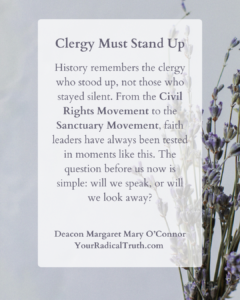 To my fellow clergy: this is a moment that demands moral courage. Silence from the pulpit in the face of intimidation, abuse, and death is not neutrality. It is complicity. The Gospel does not call us to comfort when people are being harmed. It calls us to truth.
If we cannot speak when lives are lost, when fear governs communities, and when power is exercised without restraint, then we must ask ourselves whom we truly serve. Now is the time to stand, to speak, and to insist that human dignity is not negotiable.
Choosing Life, Dignity, and Mercy
Prayer matters. Lament is necessary. But faith that stops there is incomplete.
The gray has faded. The moral line is clear.
We must choose life.
We must choose dignity.
We must choose mercy.
Anything less is a betrayal of the Gospel we claim to serve.
About Deacon Margaret Mary O’Connor
Deacon Margaret Mary O’Connor, a former member of the Catholic laity, once believed she understood her Church and its teachings. Everything changed the day she uncovered a centuries old scandal of lies and institutional cover up surrounding the history of women in ordained ministry. Realizing that her own Church had hidden the truth about women priests, women deacons, and even women bishops, she felt a deep and unforgettable sense of betrayal.
That moment became the catalyst for her mission. Margaret Mary now travels what she calls the Highway of Radical Truth, exposing the layers of deception that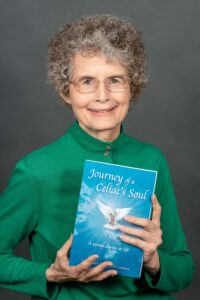 have kept millions of Catholics unaware of the prominent roles women held in early Church history. Her work challenges long held assumptions, confronts the complicity of the hierarchy, and calls Catholics to learn the real history for themselves.
For Margaret Mary, every Catholic deserves the truth. She believes transparency is not optional, especially when the suppression of women’s vocations continues to harm the Church today. Her research shines a spotlight on hidden historical records that may even hold answers to the modern priest shortage.
Often described as a Modern Day David, Margaret Mary is relentless in her commitment to revealing what has been intentionally concealed. Through her well researched writings, public advocacy, and ministry within the Celtic Christian Church, she brings these buried truths to light.
She is the author of Scandal in the Shadows and Journey of a Celiac’s Soul, and remains a force for honesty, courage, and reform within the broader Catholic conversation.